Truist Assist
Truist Assist
Truist Assist
Defining and Launching an AI Assistant to Modernize Digital Banking
Defining and Launching an AI Assistant to Modernize Digital Banking
Defining and Launching an AI Assistant to Modernize Digital Banking
Role
Lead UX / Product Designer

Overview
Overview
Overview
Customers lacked an intuitive way to complete tasks and get support within the product, relying on a static chatbot with limited capabilities. I led the design of a next-generation AI assistant, defining how conversational experiences could support task completion, reduce friction, and scale across the product ecosystem.
Customers lacked an intuitive way to complete tasks and get support within the product, relying on a static chatbot with limited capabilities. I led the design of a next-generation AI assistant, defining how conversational experiences could support task completion, reduce friction, and scale across the product ecosystem.
Customers lacked an intuitive way to complete tasks and get support within the product, relying on a static chatbot with limited capabilities. I led the design of a next-generation AI assistant, defining how conversational experiences could support task completion, reduce friction, and scale across the product ecosystem.
Discover: understanding the problem
Discover: understanding the problem
Discover: understanding the problem
The existing chatbot relied on pre-scripted responses, creating a rigid experience that failed to support real user needs.
• Unable to understand natural language effectively
• Limited to basic, predefined responses
• Could not support meaningful task completion
Why this mattered:
Customers weren’t just asking questions—they were trying to accomplish tasks. The experience created friction and often pushed users to call centers for support.
The existing chatbot relied on pre-scripted responses, creating a rigid experience that failed to support real user needs.
• Unable to understand natural
language effectively
• Limited to basic, predefined responses
• Could not support meaningful task
Increase spacing between bullet
points for phone completion
Why this mattered:
Customers weren’t just asking questions—they were trying to accomplish tasks. The experience created friction and often pushed users to call centers for support.
Define: framing the problem
Define: framing the problem
Define: framing the problem
The opportunity was to move beyond a traditional chatbot and define a more intelligent assistant experience.
Core Problem:
How might we create an assistant that helps users complete tasks, not just answer questions?
Experience Principles
Support task completion, not just information retrieval
Integrate seamlessly into the product experience
Reflect natural language and real user behavior
Build trust through clarity and predictability
Why these principles:
They ensured the assistant delivered real value, rather than becoming another underutilized feature.
The opportunity was to move beyond a traditional chatbot and define a more intelligent assistant experience.
Core Problem:
How might we create an assistant that helps users complete tasks, not just answer questions?
Experience Principles
Support task completion, not just information retrieval
Integrate seamlessly into the product experience
Reflect natural language and real user behavior
Build trust through clarity and predictability
Why these principles:
They ensured the assistant delivered real value, rather than becoming another underutilized feature.
Develop: exploring solutions
Develop: exploring solutions
Develop: exploring solutions
Research & Benchmarking
• Conducted competitive analysis (e.g., Verizon, Bank of America)
• Reviewed emerging patterns in AI-driven assistants
• Partnered with call center teams to understand:
• Common customer questions
• Language patterns and phrasing
• High-frequency support scenarios
Why this approach:
Grounding the experience in real user behavior ensured the assistant felt intuitive and addressed actual customer needs.
Research & Benchmarking
• Conducted competitive analysis (e.g.,
Verizon, Bank of America)
• Reviewed emerging patterns in AI
driven assistants
• Partnered with call center teams to
understand:
• Common customer questions
• Language patterns and phrasing
• High-frequency support scenarios
Why this approach:
Grounding the experience in real user behavior ensured the assistant felt intuitive and addressed actual customer needs.
Guiding Users Through Task Completion
Guiding Users Through Task Completion

Designed end-to-end conversational flows that guide users from intent to action, enabling them to complete tasks such as money transfers directly within the assistant.
Designed end-to-end conversational flows that guide users from intent to action, enabling them to complete tasks such as money transfers directly within the assistant.
Concept Exploration
• Explored multiple directions:
• Chat-based interactions
• Action-driven assistant experiences
• Contextual assistance embedded in flows
• Low-fidelity flows to define interaction models
• High-fidelity concepts to communicate vision
Why multiple directions:
This helped identify the most effective way to balance usability,
scalability, and user trust.
Concept Exploration
• Explored multiple directions:
• Chat-based interactions
• Action-driven assistant experiences
• Contextual assistance embedded in
flows
• Low-fidelity flows to define interaction
models
• High-fidelity concepts to communicate
vision
Why multiple directions:
This helped identify the most effective way to balance usability,
scalability, and user trust.
Supporting Exploratory Conversations
Supporting Exploratory Conversations

Designed conversational patterns that allow users to explore financial insights through natural language, supporting follow-up questions and progressively deeper understanding.
Designed conversational patterns that allow users to explore financial insights through natural language, supporting follow-up questions and progressively deeper understanding.
Conversation Design
• Designed realistic conversational flows:
• User utterances
• System responses
• Multi-step interactions
Why this mattered:
Showing real interactions made the experience tangible for stakeholders and reduced ambiguity around how the assistant would function.
Conversation Design
• Designed realistic conversational
flows:
• User utterances
• System responses
• Multi-step interactions
Why this mattered:
Showing real interactions made the experience tangible for stakeholders and reduced ambiguity around how the assistant would function.
Designing Entry Points for Assistant Access
Designing Entry Points for Assistant Access
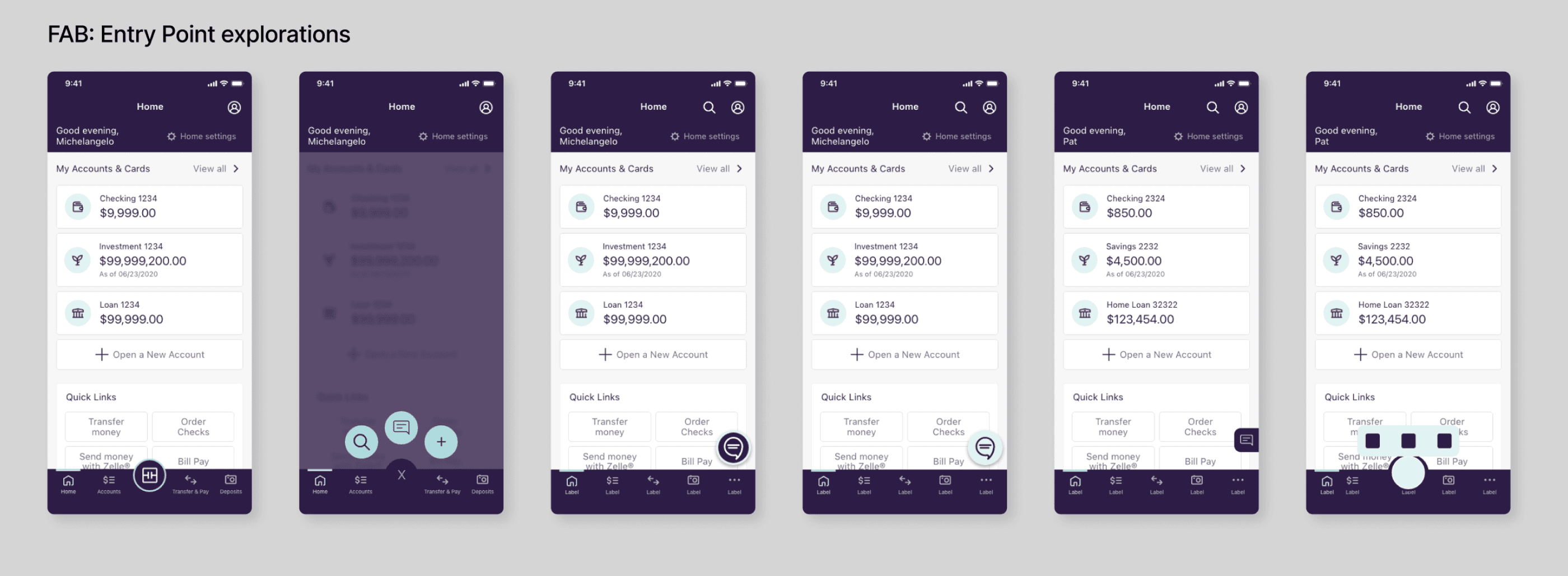
Explored multiple entry points across the product to determine how users would discover and access the assistant, balancing visibility with non-intrusiveness.
Explored multiple entry points across the product to determine how users would discover and access the assistant, balancing visibility with non-intrusiveness.
Supporting Complex Financial Journeys
Supporting Complex Financial Journeys

Designed guided conversational experiences to support complex financial decisions, such as home buying, combining education, recommendations, and step-by-step progression.
Designed guided conversational experiences to support complex financial decisions, such as home buying, combining education, recommendations, and step-by-step progression.
Deliver: refining & aligning the solution
Deliver: refining & aligning the solution
Deliver: refining & aligning the solution
Stakeholder Alignment
• Presented concepts across Product, Design, and Engineering
• Used high-fidelity designs to:
• Communicate vision clearly
• Build confidence in feasibility
• Drive alignment across teams
Why this approach:
AI-driven experiences can feel abstract—visualizing real interactions helped stakeholders understand the value and potential impact.
Transition to Execution
• Collaborated with stakeholders to define initial feature set
• Bill Pay
• Call Center / Live Agent systems
• Helped bridge:
• Self-service capabilities
• Assisted support experiences
Why this mattered:
Ensured the assistant could scale across the product ecosystem and support real customer journeys.
Stakeholder Alignment
• Presented concepts across Product,
Design, and Engineering
• Used high-fidelity designs to:
• Communicate vision clearly
• Build confidence in feasibility
• Drive alignment across teams
Why this approach:
AI-driven experiences can feel abstract—visualizing real interactions helped stakeholders understand the value and potential impact.
Transition to Execution
• Collaborated with stakeholders to
define initial feature set
• Bill Pay
• Call Center / Live Agent systems
• Helped bridge:
• Self-service capabilities
• Assisted support experiences
Why this mattered:
Ensured the assistant could scale across the product ecosystem and support real customer journeys.
Key Decisions
Key Decisions
Key Decisions
Shift from Scripted Chatbot → Learning Assistant
• Moved toward a model capable of understanding natural language
and adapting over time.
Focus on Task Completion
• Designed the assistant to help users take action, not just retrieve information.
• Integrate Across the Experience
• Positioned the assistant as part of key journeys rather than a standalone tool.
• Use High-Fidelity Concepts to Drive Buy-In
Shift from Scripted Chatbot
→ Learning Assistant
Moved toward a model capable of understanding natural language
and adapting over time.
Focus on Task Completion
• Designed the assistant to help users
take action, not just retrieve
information.
• Integrate Across the Experience
• Positioned the assistant as part of key
journeys rather than a standalone tool.
• Use High-Fidelity Concepts to Drive
Buy-In
Outcome
Outcome
Outcome
The work successfully influenced leadership and secured funding
for the assistant initiative.
• The concept evolved into a fully supported product initiative
• The assistant is now live and continues to expand with new capabilities
• Established a foundation for AI-driven experiences within the product
Impact:
This work transformed the organization’s approach from a static chatbot to a scalable, assistant-driven experience model.
The work successfully influenced leadership and secured funding
for the assistant initiative.
• The concept evolved into a fully
supported product initiative
• The assistant is now live and continues
to expand with new capabilities
• Established a foundation for AI-driven
experiences within the product
Impact:
This work transformed the organization’s approach from a static chatbot to a scalable, assistant-driven experience model.
Assistant Experience Across the Product Lifecycle
Assistant Experience Across the Product Lifecycle

Extended the assistant beyond a single interface, integrating it across entry points, notifications, and completion states to create a cohesive end-to-end experience.
Extended the assistant beyond a single interface, integrating it across entry points, notifications, and completion states to create a cohesive end-to-end experience.
Key Learnings
Key Learnings
Key Learnings
What I’d do differently:
Align earlier on technical constraints
Define initial scope more tightly to accelerate delivery
What went well:
Strong cross-functional alignment
Effective use of visuals to influence strategy
Bridged conversational and product design effectively
What I’d do differently:
Align earlier on technical constraints
Define initial scope more tightly to accelerate delivery
What went well:
Strong cross-functional alignment
Effective use of visuals to influence strategy
Bridged conversational and product design effectively
Other Case Studies
Other Case Studies
Other Case Studies
Designing a Contextual Recommendation Strategy to Drive Relevance and Product Adoption
Designing a Contextual Recommendation Strategy to Drive Relevance and Product Adoption

Improving Findability of Statements & Tax Documents in a Consumer Financial Platform
Improving Findability of Statements & Tax Documents in a Consumer Financial Platform